Normally, I am not one to speculate on the future of the office. Too many self-acclaimed futurologists announce workplace trends in regular intervals, often with little scientific underpinning. When someone would have asked me in the past to comment on the future of the office, my standard reply would have been, sorry, my crystal ball is currently broken. That is not to say that forecasting is futile, clearly, lots of climate models, for example, are important policy instruments but if done well they are fed by millions of data points and sophisticated simulations – something that the workplace industry generally does not have.
So, what made me change my mind? Well, data of course.
I have been fortunate enough to have been involved in an amazing collaborative research project over the last months and what we found has been fascinating, so bear with me as a I outline why I think that the future of the office lies in generosity.
You may not need convincing that the workplace has undergone significant changes ever since the Covid-19 pandemic has surged around the globe in 2020, but here is a quick run through anyway: first, we were all sent home with little to no advance warning, as offices had to close to limit the spread of infections, sometimes for months or years on end (personally, I did not enter my office regularly again all the way until September 2021). Then came the calls for a ‘return to work’, often sounding desperate, as CEOs and managers tried luring (or simply mandating) employees back to the office, which many were unwilling to comply with, not keen to brave endless commutes and give up on the rewarding flexibility of working from home. Finally, many organisations settled on hybrid work, aiming to combine the best of both worlds, the flexibility of working from home and the benefits of teamwork and in-person encounters; yet many underestimated the complexities of making hybrid work.
As we were arguing in a 2023 paper published in the open access journal Buildings & Cities (co-authored with my brainybirdz colleagues Rosi Pachilova and Matt Thomas), hybrid work means that individuals might need to develop new levels of self-discipline, managers need to change their leadership styles, the physical layout of the office needs to adapt, IT departments need sociological insights and facility managers need a new playbook. This is far from obvious and poses real challenges to organisations.
In 2023, based on our small sample size of interviews with participants practising hybrid work in the UK, we saw little evidence that office layouts had adapted to the new realities of more flexible working processes.
However, the time felt ripe to look again.
Hence in this project, run in collaboration with and funded by design practice AIS Interiors, we asked whether offices designed after 2020 differed significantly in design choices from their pre-pandemic counterparts (see end of the post for a link to the full report).
Why is this so important?
Offices designed now will be inhabited by organisations for the next ten to twenty years, possibly even longer. Stewart Brand in his seminal 1994 book ‘How buildings learn’ introduced the concept of six shearing layers and those related to interior design – services and space plans – are meant to be in place for years if not decades. One might argue that the overall structure of a workplace (such as the shape of the floor plate) is also relevant to interior design choices, and this is typically associated with a lifespan of at least thirty years. As such, workplace designs created now form a lasting physical foundation for how work is going to unfold over the years and decades to come.
Hence, in order to understand how workplace designs had changed after the pandemic, we analysed a total of eighteen AIS workplace layouts in the project, nine were completed before the pandemic in 2018 and 2019 and another nine from 2021 onwards. Working with the floor plans in CAD and Revit, we drew polygons around each functional space to measure their areas and compared a whole series of metrics (19 in total) that collectively described crucial design decisions, including area allocations to key functions, counts of important amenities, areas per seat and the size of office neighbourhoods.
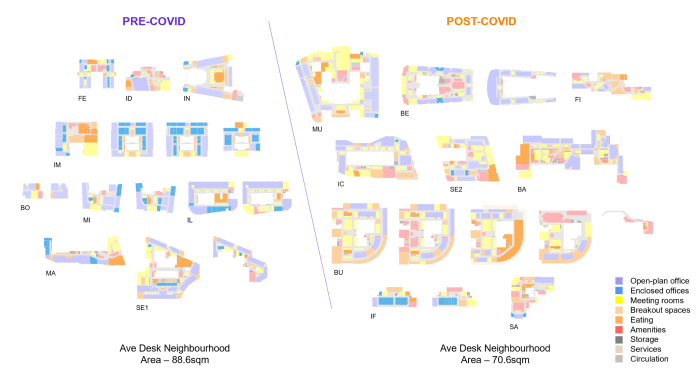
What we found was fascinating.
Five metrics resulted in statistically significant differences between the pre- and post-pandemic sample, so that means that workplace design had changed so much within a short time frame that differences held up statistical scrutiny.
So, what has changed?
- The area allocated to desks (open-plan and enclosed offices) has shrunk from 43% to 23% with three post-pandemic cases even offering less than 16% of net internal area dedicated to desking.
- Collaborative spaces (meeting rooms, breakout spaces, eating areas, amenities) now take up almost half up the workplace net internal area (47%, up from 34%).
- Seating opportunities shift from desk-based seats to alternative seats. For every ten desk-based seats, post-pandemic offices offered 23 alternative seats (up from 13).
- Desk allowances, i.e., the area available per desk on average (often also described as density but here we prefer allowance as an easier term) rose from 11.9 to 17.9 sqm. Four of the nine post-pandemic cases even offered more than 20sqm per desk on average.
- Post-pandemic offices are more granular, as the average area of a neighbourhood (continuous functional area of any single type) has decreased by 20% and now measures only 71 sqm.
These results confirm a fundamental shift in workplace design. Offices are no longer designed to hold seas of desks or large areas that all look the same; offices are no longer tightly packed to optimise for efficiency. Instead, workplaces designed from 2021 onwards are made for social encounters, collaboration and a diversity of activities.
This also challenges the latest BCO guidelines on office utilisation (from 2025), which continue to recommend an area allowance of only 10-12 sqm per desk, since hybrid work was assumed to result in underutilisation and therefore the office might be perceived as less densely packed.
Our research paints a very different picture with a much more relaxed average allowance of 17.9 sqm per desk. Organisations (articulating their needs in a brief) and designers (creating spaces from that brief) have obviously moved on and recognised that density is no longer a relevant metric in the world of hybrid work.
We also challenge the approach to estimate office areas solely based on desks. If desking only makes up 23% of the area, the majority of spaces required (77%) are needed for different functions. Our data suggests a four quarters approach with roughly one fourth of the area needed each for desking, collaborative spaces, meeting spaces and circulation.
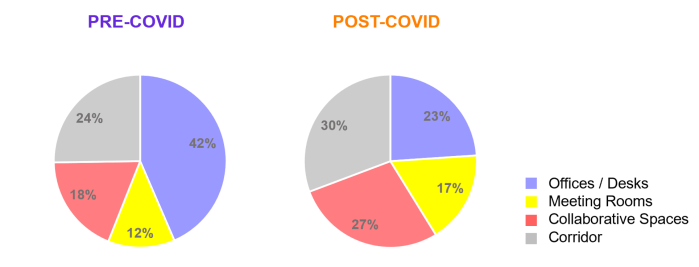
Corridor spaces deserve a mention in their own right. In our sample, their area rose from 24% to 30% (yet not quite statistically significant).
Again, this deviates significantly from the pre-pandemic logic of minimising corridor areas – I recall my early days in workplace consultancy and space planning where a practice I worked for in the late 2000s boasted that they could plan so efficiently that only 15% of space was ‘wasted’ on circulation. Instead, we suggest that corridors act as crucial infrastructure, enabling social exchange and unplanned encounters.
So, what is the future of the office? It lies in generosity. The generosity of allowing spaces to breathe; to not pack offices as densely as desk layouts allow; to accept that corridor spaces are needed, not just to connect diverse and granular neighbourhoods, but also as spaces in their own right, for colleagues to meet each other, interact, move, change perspective; to understand that smaller neighbourhoods and more granular design provides more intimate areas, which were preferred by employees in a pre-pandemic study of an open-plan office. Doesn’t that sound like an office you’d also want to work in?
Interested to learn more?
The full report ‘The Space Between’ can be downloaded from AIS directly.
An academic paper with detailed results has been accepted for presentation at the 5th Transdisciplinary Workplace Research (TWR) Conference, held 2-5th September 2026 in Zurich. A copy is available here.
Curious how your own organisation can conduct unique workplace research? Contact us.


